LearnWell Kids Blog | Smart Learning For Every Child
LearnWell Kids
Smart Learning For Every Child  ·  Est. 2026

Child Learning Specialist Reveals a Simple Recall Method That Helps Struggling Children Understand Lessons The First Time And Hold What They Learn (Without Extra Tutors, Without Cramming Before Exams, And Without Nightly Homework Battles)

Child struggling with schoolwork

You know what is worse than watching your child fail?

Watching your child try. And still fail.

Every single term.

The homework is done. The notes are written. The lesson teacher came twice this week. The child sat at that table for two hours with the textbook open.

And the next morning, it is gone.

Like water poured into a basket.

You have watched this happen so many times that your body already knows what is coming before the report card arrives.

That heaviness in your chest when the school WhatsApp group lights up with congratulations messages for other people's children. And your phone just sits there. Silent.

That heat behind your eyes when you open the report card in the corridor and the numbers hit you before you can prepare your face.

That tightness in your stomach when you walk back to the car, smiling at other parents, praying nobody asks, "How did she do?"

First term, you told yourself it was just the adjustment. "She is still settling in."

Second term, you hired a lesson teacher. Two sessions a week.

Third term, you added a second lesson teacher. Still the same result.

By the fourth term, you stopped opening the report card in front of anyone. You waited until you were alone. Because the look on your face when you saw the scores was not something you wanted your husband to see.

You have paid for lesson teachers. One was not enough, so you paid for two.

You have sat with the child after dinner, going over the same topic for the fourth time, your voice rising before you even realise it.

You have bribed. "If you come first this term, I'll buy you..."

You have threatened. "If this result doesn't improve..."

You have pleaded. "Please. Just try harder."

And the child looks at you with those eyes. The eyes that say:

"Mummy, I AM trying."

That look. That is the one that breaks you.

Because you know the child is telling the truth.

They ARE trying. The information just does not stay.

And then come the moments that make it worse.

Your mother-in-law at Sunday lunch: "This child, is she not taking after your side? Because in our family, everybody is sharp."

Your husband after the third school fees payment: "How much are we paying these lesson teachers? Because I am not seeing any result."

Your neighbour whose daughter came first, again, saying with that smile: "Oh, don't worry. Every child has their own pace."

You smile back. You nod. You swallow it.

But at night, after the children are asleep and the house is quiet and your husband has rolled over with his back to you, the thoughts you have never said to anyone start:

"Why is this child not getting it?"

"Am I failing as a mother?"

"What if... what if my child is actually not as bright as I thought?"

That last question.

The one you have never typed. Never spoken. Never whispered even to yourself in the bathroom mirror.

That is the one that sits on your chest at 2am while the ceiling fan goes round and round and you are staring at the darkness, wondering if your child's future is slipping away while you watch.

Wondering if primary school is already too late.

Wondering what happens at WAEC. At JAMB. At the moment when it really counts and there are no more lesson teachers to hire and no more terms to wait.

If that weight is sitting on your chest right now, then every single word on this page was written for you.

Because I have spent the last 12 years working with children exactly like yours. Children who are bright at home but invisible on the report card. Children who study hard but forget everything. Children whose mothers have spent hundreds of thousands on tutors and still lie awake at night carrying the same fear you are carrying right now.

And what I discovered about WHY they forget changed everything.

Because what I am about to share with you can stop that 2am ceiling-fan moment for good. And it starts with understanding one thing every school in Nigeria gets wrong.

How I Stumbled On What Every Teacher Missed

My name is Mrs. Nneka Obi.

Mrs. Nneka Obi - Child Learning Specialist

I am a child learning specialist. Not a classroom teacher. Not a tutor. Not a psychologist.

I am someone who has spent the last 12 years doing one thing: figuring out why bright children forget everything they study, and what to do about it.

I have sat across the table from more than 300 mothers who looked at me with the exact same expression you are wearing right now. Exhausted. Desperate. Ready to try anything.

And I can tell you one thing with absolute certainty:

The problem is almost never the child. The problem is the METHOD.

Let me tell you how I found out.

The Mother Who Cried In My Office

Twelve years ago, a woman named Mrs. Okafor walked into my office with her son, Chukwuemeka. Primary 4.

She sat down, put her bag on her lap, and before I could even greet her properly, her eyes filled with tears.

"Mrs. Nneka, this boy is not dull," she said, her voice shaking. "At home, he explains things to his younger sister perfectly. He remembers every single word from a Nollywood film he watched one time. But the moment it is schoolwork, everything disappears. I have spent over ₦150,000 on lesson teachers in two years. Nothing has changed. His father says I am wasting money. The school says he is slow. But I KNOW this child is not slow."

She wiped her eyes with the back of her hand and whispered:

"Please. I don't know what else to do."

I looked at Chukwuemeka. He was staring at his shoes. Quiet. Ashamed. A 9-year-old boy who had already decided he was stupid.

I asked him to sit with me. I gave him a list of 15 items to memorise. Fruits, animals, random objects. Nothing from school.

He did what every child is taught to do. He read the list. Read it again. Then again. Lips moving, eyes scanning, the same line over and over.

After 20 minutes, I took the list away.

"Tell me what you remember."

He squeezed his eyes shut. His fists clenched.

Four. He remembered four out of fifteen.

His mother's face fell. She looked away.

Then I tried something different. Something I had been reading about in education research from universities in the UK and US, but had never seen applied in a single Nigerian classroom.

Instead of asking him to read the list again, I said: "Close your eyes. Don't try to remember the words. Try to remember WHERE on the page they were. Top? Bottom? Near the middle?"

He pulled two more.

Then I asked him to do something that made him laugh. "Put the banana with the monkey. Now imagine the monkey eating the banana while sitting on top of the table. Can you see it?"

He grinned. "That is funny."

"Good. Now close your eyes. What do you see?"

Eleven. He recalled eleven out of fifteen.

In five minutes. Without reading a single word again.

His mother was standing in the doorway. Her hand was over her mouth.

"How did you do that?" she whispered. "That is the same boy. The SAME boy. How did he just..."

She could not finish the sentence.

Chukwuemeka looked up at me, and for the first time since he walked in, he smiled.

"Mrs. Nneka... that was easy."

A boy who had been told he was slow for two years. A boy whose father called him a waste of school fees. A boy who stared at his shoes in shame.

That boy just said "that was easy."

His mother started crying again. But this time, it was different.

That moment changed everything for me. Not because of the technique. But because of what it revealed.

Chukwuemeka was never the problem. The method was the problem. And it had almost destroyed this child's belief in himself.

What I Discovered Next Made Me Angry

After Chukwuemeka, I dug into everything. Education journals. Research papers. Studies on how children's brains actually store and retrieve information.

And I found something that made me angry and relieved at the same time:

The way Nigerian schools teach children to study, "read it again, write it ten times, go over your notes before bed," is scientifically proven to be among the LEAST effective methods for retaining information.

What actually works are four simple principles that education researchers have tested on children in exactly this age range and found to dramatically improve how much they hold. Principles so simple that the first time I showed a mother, she said: "That is IT? That is all?"

And three weeks later, her son's teacher was asking what had changed.

I spent the next 12 years turning those four principles into a step-by-step system any parent can run at home. No training needed. No expensive materials. Just a parent, a child, and 15 minutes a day.

What Happens When You Start

I have watched this pattern repeat with over 300 children. It is almost always the same:

Day 1: The child resists. "This is weird. Why can't I just read it normally?" They are used to the old way. You push through gently.

Day 2: Still awkward. The child cooperates but does not trust it. You wonder if this is another waste of time.

Day 3: Nothing visible yet. You catch yourself reaching for the lesson teacher's number.

Day 5: A small shift. The child finishes homework faster than usual. Not dramatically, just... faster. You almost miss it.

Day 7: You are eating dinner. The child says something about a topic from school, casually, without being asked. Something they studied four days ago. You stop chewing. You look at your husband. He did not notice. But YOU noticed. Because that has never happened before.

Day 10: Homework time. The child sits down, opens the book, and starts working. No argument. No "let me finish this cartoon first." No tears. You stand in the kitchen doorway watching, afraid to move in case you break whatever spell this is.

Day 14: The class teacher pulls you aside at pick-up. "Mrs..., I want to ask you something. What are you doing differently at home? Because this child is participating in class. She raised her hand three times today. She has never done that before."

That moment. Standing in the school corridor, hearing those words from the teacher's mouth.

THAT is the moment every mother I have worked with describes as the one where everything changed.

Not the report card. Not the test score.

The moment someone else saw what you were afraid to believe.

The Evening That Made It Real

Mrs. Okafor, Chukwuemeka's mother, called me six weeks after we started.

She was speaking so fast I had to ask her to slow down.

"Mrs. Nneka, listen to what happened. We were eating dinner. My husband, myself, Chukwuemeka, and his sister. My husband asked the children, 'What did you learn in school today?' The way he always does. And usually Chukwuemeka just shrugs and says 'nothing.'"

"But last night, he started talking. He explained the entire lesson on the water cycle. How water evaporates from rivers, forms clouds, falls as rain. He used the EXACT words from the textbook. And then he turned to his sister and said, 'Let me teach you.' And he taught her. At the dinner table. My husband put his fork down and stared at me."

She paused. Then she said:

"My husband looked at me and said, 'What happened to this boy? This is not the same child.' And I just smiled. Because for two years, that man told me I was wasting money. That the boy was just not a book person. That some children are sharp and some are not. And now he is staring at his son like he is seeing him for the first time."

She was crying by this point. And honestly, so was I.

Then she said something that lodged in my chest and has never left:

"Mrs. Nneka, you did not just help my son remember his lessons. You gave me back my child. The child I always knew was in there."

It Was Not Just Chukwuemeka

After Mrs. Okafor, I gave the same system to nine more mothers. Different children. Different ages. Different schools. Different subjects they were struggling with.

The results followed the same pattern every single time.

Mrs. Adebayo in Abuja — her daughter was in Primary 3, struggling with Basic Science. After three weeks: "My daughter came home and explained photosynthesis to my house girl. My HOUSE GIRL. This is a child who could not tell me what she ate for lunch at school."

Mrs. Hassan in Kano — her son was preparing for Common Entrance. She was spending ₦20,000 a month on tutorials. After one month with the system: "I cancelled the tutorials. He is scoring higher on practice tests than he ever scored with the tutor. ₦7,500 saved me ₦60,000 a term."

Mrs. Eze in Lagos — twin boys, same school, same class. One excelling, one struggling. She used the system with the struggling twin only. End of term: "They are neck and neck. Same child. Different method. Completely different result."

Same system. Same four principles. Different children. Different cities.

Same result.

Why I Decided To Share This

For years, I kept this system inside my practice. I worked with children one by one, mother by mother.

But I kept meeting the same woman everywhere. At church. At the school gate. At family gatherings. The mother carrying the quiet fear that her child is falling behind and she cannot stop it.

I cannot sit across the table from every mother in Nigeria. But I can put everything I know into one guide and let it reach the mothers I will never meet.

That is why this exists.

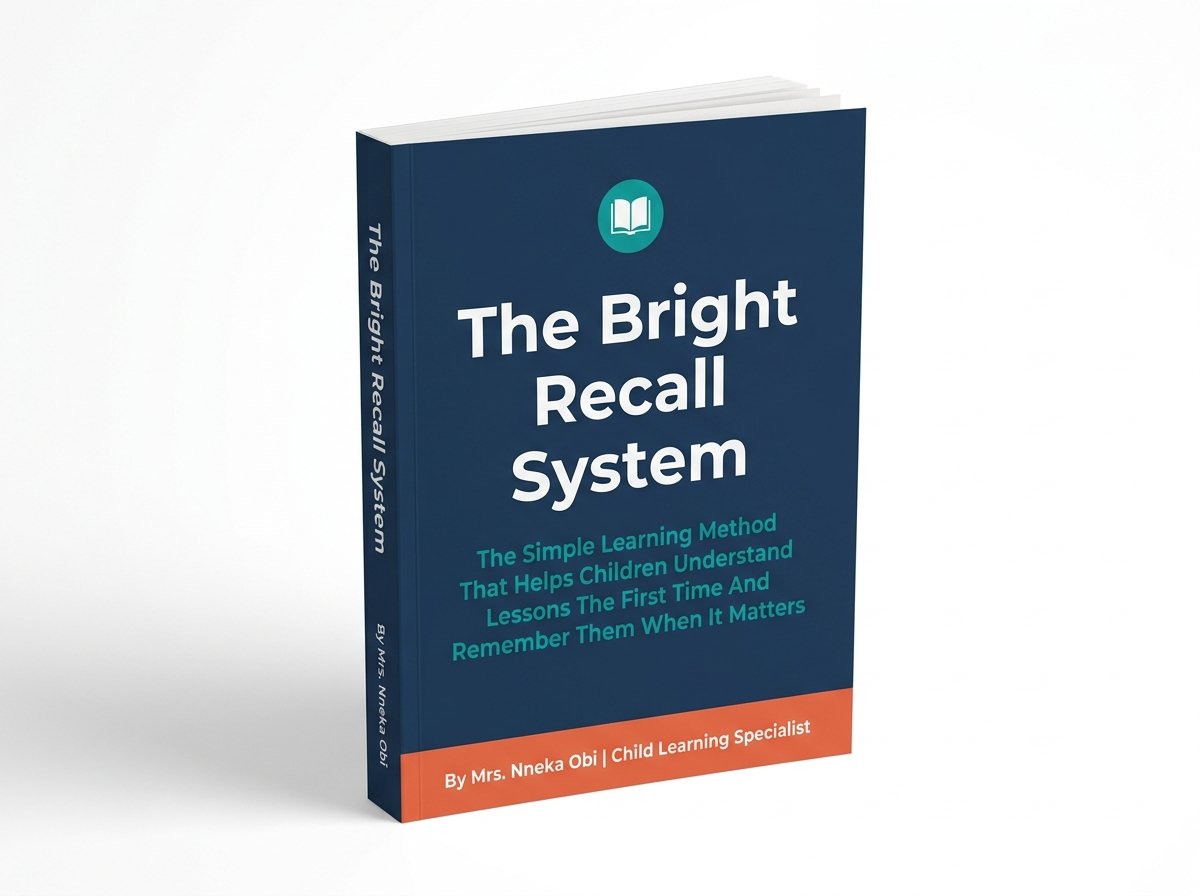
Introducing: The Bright Recall System

The Bright Recall System Guide

The Bright Recall System: The Simple Learning Method Quietly Used By Child Education Specialists. That Helps Children Understand Lessons The First Time And Remember Them When It Matters, Without Extra Tutors, Without Cramming Before Exams, and Without Nightly Homework Battles.

Everything I have learned in 12 years of working with struggling children, distilled into one clear, actionable guide a parent can start using tonight.

Inside this guide, you will discover:

The real reason your child forgets everything they study -- and why reading it "one more time" actually makes the problem worse, not better (Page 4)

The 15-minute evening recall routine you can start tonight. No shouting. No tears. Just a simple exercise that rewires how your child's brain stores information (Page 9)

The "Chunk and Link" method -- how to help your child break any topic into small pieces their brain can actually hold, even subjects they hate (Page 14)

The 3 study habits that make children WORSE at remembering (every Nigerian parent teaches these without knowing the damage) (Page 18)

The "Teach It Back" technique -- why asking your child to explain the lesson back to you is more powerful than any tutor (Page 22)

The 7-day, 14-day, and 21-day revision schedule that beats the brain's natural forgetting curve so nothing slips through (Page 26)

How to use this method for ANY school subject -- English, Maths, Basic Science, Social Studies, even subjects the child claims to "hate" (Page 30)

You do not need to be a teacher. You do not need to understand the subjects yourself.

You just need 15 minutes a day and the willingness to try something different.

Compare the cost of doing nothing:

Extra lesson teachers: ₦10,000 - ₦25,000 per term (and the child still forgets)
Private tutors: ₦15,000 - ₦40,000 per term (same methods, same results)
Changing schools: ₦100,000+ (the problem follows the child)
The REAL cost: Your child's confidence, their belief in themselves, their future

How Much Does This Guide Cost?

Let me be honest with you. Building this system was not cheap.

  • 12 years of working directly with struggling children: countless hours
  • Research materials and education journals: over ₦80,000
  • Testing and refining with 300 families: 4 years of iteration
  • A professional writer to organise everything clearly: ₦35,000
  • Design and production of the guide: ₦20,000

Total investment to build what you are about to hold in your hands: over ₦135,000 and 12 years.

Compare that to what you are already spending. A single term of lesson teachers costs ₦15,000 to ₦25,000. And at the end of the term, you are back where you started because the child never learned how to LEARN.

This guide teaches a skill they carry for the rest of their education. Primary school. Secondary school. University. Life.

A fair price would be ₦15,000. But because I built this to reach as many mothers as possible, and because I know what it feels like to watch a child struggle while the bills pile up, the price today is:

15,000
7,500

This introductory price is only available while this page is live.

Once you click the button above:

  • You will be taken to a simple, secure payment page
  • Complete your payment of ₦7,500
  • The complete guide plus all bonuses will be delivered to your email and WhatsApp immediately

What Parents Are Saying

Swipe to read more

These are placeholder testimonials. Replace with real parent feedback before running paid traffic.

But Wait. There Is More.

If you get The Bright Recall System today, I am including 2 bonus guides completely free:

The Homework Peace Plan

Bonus 1: The Homework Peace Plan

(Value: ₦5,000)

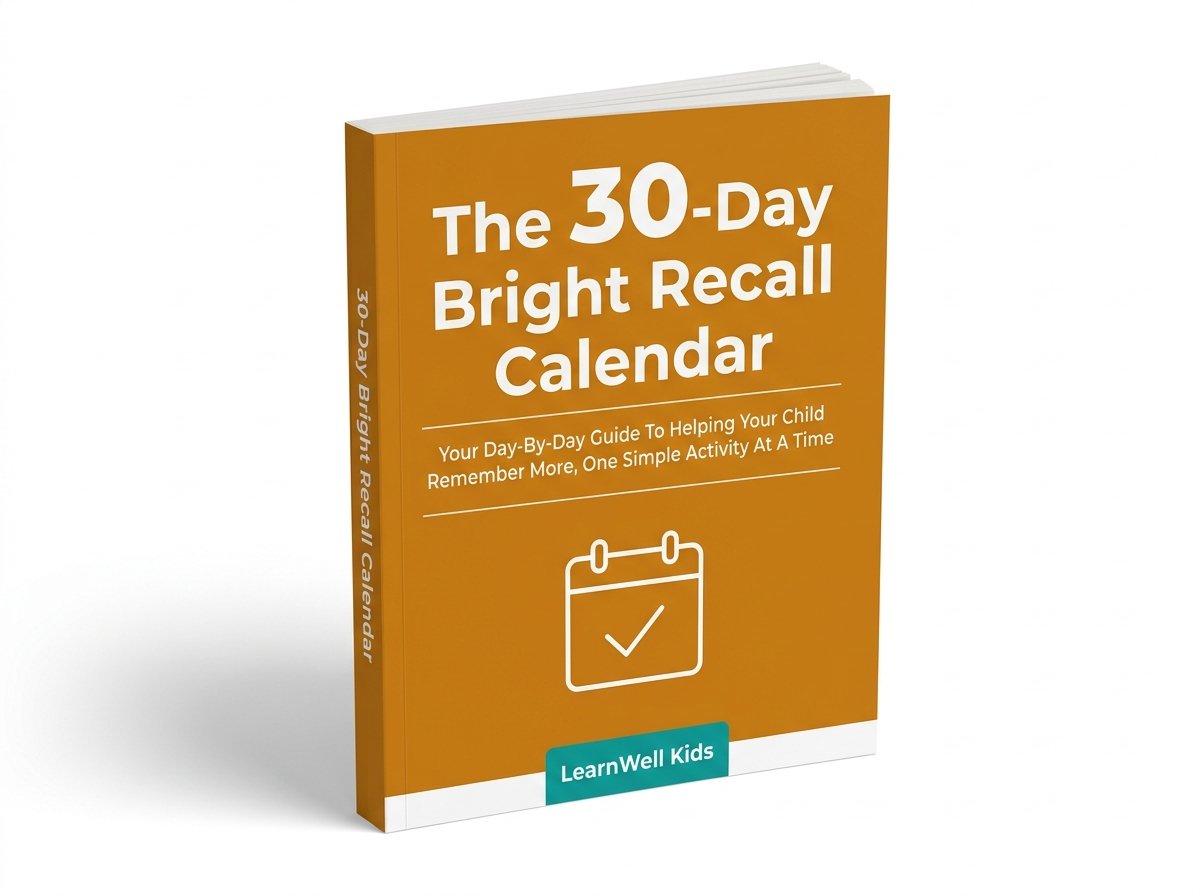
The 30-Day Bright Recall Calendar

Bonus 2: The 30-Day Bright Recall Calendar

(Value: ₦5,000)

Bonus 1: The Homework Peace Plan (Value: ₦5,000)

A simple system that turns homework from a nightly battle into a calm 20-minute routine. Includes a daily checklist, a distraction-removal guide, and a reward framework that actually works without bribery.

  • The 3-step homework start routine (no more "I'll do it later")
  • How to remove phones, TV, and distractions without a fight
  • The timer method that keeps young children focused
  • How to check homework without doing it for them

Worth ₦5,000. Yours free today.

Bonus 2: The 30-Day Bright Recall Calendar (Value: ₦5,000)

A day-by-day calendar that tells you exactly what to practise with your child for 30 days. Open it, see today's activity, do it. No guessing.

  • One activity per day, clearly explained in 2 sentences
  • Built-in progress tracker so you can see the improvement week by week
  • Works alongside any school curriculum, any subject

Worth ₦5,000. Yours free today.

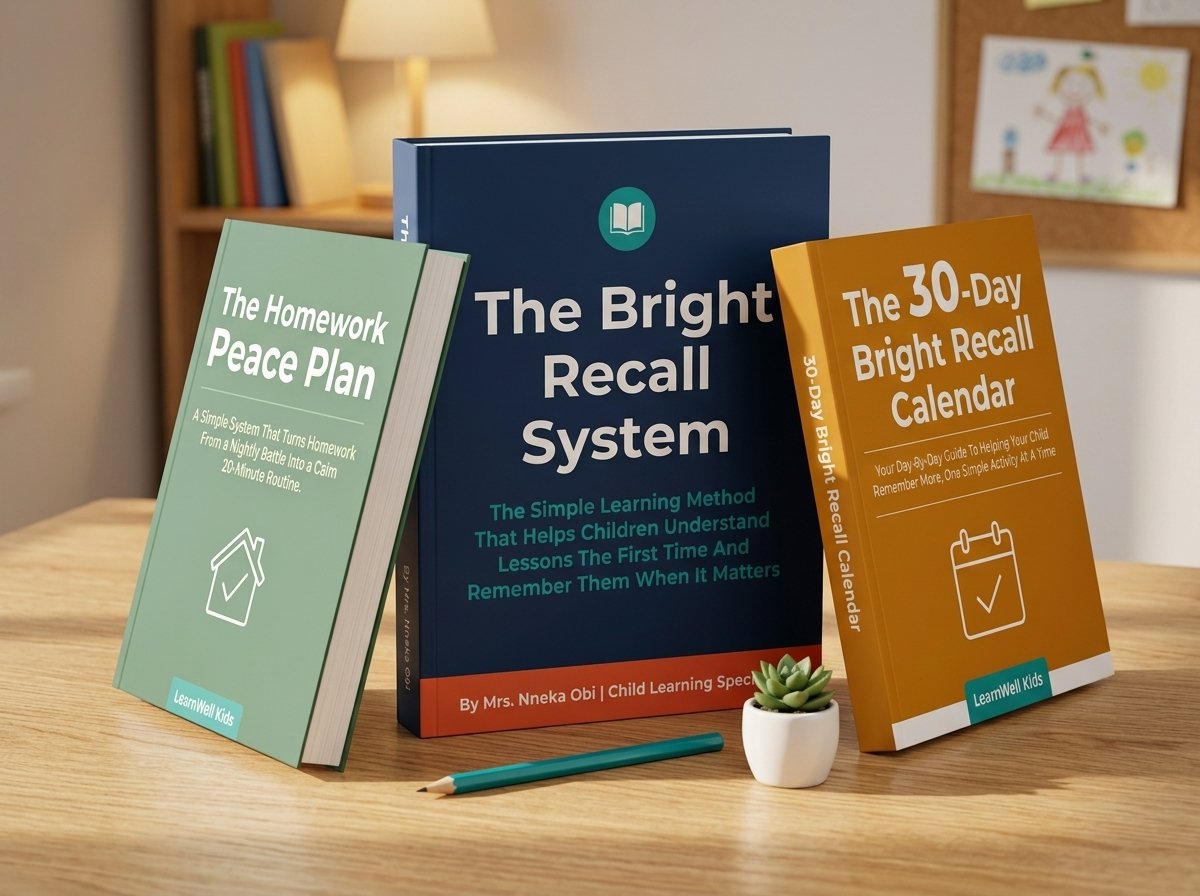
Everything You Are Getting Today

The Complete Bright Recall System Bundle
✓ The Bright Recall System (Core Guide) ₦15,000
✓ The Homework Peace Plan ₦5,000
✓ The 30-Day Bright Recall Calendar ₦5,000
Total Value: ₦25,000
You Pay Today: ₦7,500
Only
15
spots left at this price

My 30-Day Promise To You

Get the guide today. Use it with your child for 30 days.

If homework evenings are not calmer... if your child is not remembering things they studied days ago... if their teacher has not noticed a difference...

Send me a message and I will refund every single kobo. No drama. No questions. No wahala.

Your child's education is too important for you to hesitate over ₦7,500. I am putting my own money behind this promise because I have seen it work with over 300 children. You have nothing to lose and everything to gain.

Right Now, You Have Two Choices

Choice 1: Close this page

Continue paying for lesson teachers who use the same methods that are not working.

Continue dreading report card day. Continue opening it alone because you cannot bear to see the numbers in front of anyone.

Continue smiling at the neighbour whose daughter came first, again, while your phone stays silent in the school WhatsApp group.

Continue lying awake at 2am, staring at the ceiling fan, wondering if your child's future is already slipping.

Maybe the problem will fix itself.

(It will not. It never does. And every term you wait is another term the gap widens.)

Choice 2: Try something different

Imagine 30 days from now...

Your child finishes homework without a single argument. You stand in the doorway watching, afraid to breathe in case you break the spell.

At dinner, they explain a topic from school, casually, without being asked. Your husband puts his fork down. Looks at you.

The class teacher pulls you aside at pick-up: "What are you doing differently at home?"

And on report card day, you open it in the corridor. In front of everyone. Because this time, you already know what the numbers say.

Your mother-in-law has nothing to say at Sunday lunch. The WhatsApp group sends a congratulations message. And this time, it is for YOUR child.

All of that starts with one decision. The one you make right now.

Questions Parents Ask

My child is only 6. Is this too advanced?
No. The system is designed for children aged 6 to 12. For younger children (6 to 8), the guide includes a simplified version of each technique with age-appropriate activities. The core principles work at any age because they are based on how the brain stores information, and that process is the same whether the child is 6 or 12.
Will this work if my child has been labelled "slow" at school?
In my 12 years of working with children, I have found that the vast majority of children labelled "slow" are not slow at all. They are children whose brains process information differently from the way the school teaches it. The recall methods in this guide work specifically because they bypass the "read and repeat" approach that fails these children. Some of my most dramatic results have come from children their schools had given up on.
I am not a teacher. Can I really do this?
Yes. This guide was built for parents, not teachers. Every technique is written in plain language with step-by-step instructions. You do not need to understand the subject matter. You just need to follow the routine. If you can spend 15 minutes a day sitting with your child, you can run this system.
What subjects does this work for?
All of them. The Bright Recall System is not a content guide for any specific subject. It is a method for how to study ANY subject so the information sticks. Maths, English, Basic Science, Social Studies, Civic Education, even the subjects your child claims to hate. The guide includes worked examples across multiple subjects.
We already have a lesson teacher. Should I stop that?
Not necessarily. But understand this: a lesson teacher who uses the same "read and repeat" method as the school is giving you more of what is already not working. This guide can work alongside a tutor or it can replace one entirely. Many parents in our community found they no longer needed a tutor after the second month.
How soon will I see results?
Most parents notice a shift in the first 7 to 14 days. Not necessarily in test scores (those take a full term to reflect), but in how the child studies: less resistance, better recall during homework, calmer evenings. By the end of the first month, the improvement is usually clear to everyone, parents, teachers, and most importantly, the child.
Is this just another "study tips" PDF?
No. Study tips are general advice. This is a structured, day-by-day system with specific techniques, worked examples, and a 30-day implementation calendar. The difference is the same as the difference between someone telling you "eat healthy" and someone handing you a meal plan with a shopping list. One is advice. The other is a system you can follow.
What if it does not work for my child?
Then you send me a message and I refund your ₦7,500. Full stop. I offer a 30-day money-back promise because I have seen this work with hundreds of children across every learning style. But if your child is the exception, you lose nothing.
My child has been diagnosed with ADHD or a learning difficulty. Will this still help?
Many children with attention or learning challenges respond well to these techniques because the system uses multi-sensory methods, not just reading and repeating. That said, this guide is not a medical intervention. If your child has a diagnosed condition, use this system alongside the support their specialist recommends, not as a replacement. For many families, it has been a powerful complement to professional support.
I have bought educational guides before and none of them worked. Why is this different?
Most study guides teach WHAT to study. This one teaches HOW to study. The difference is the same as the difference between giving someone a recipe and teaching them how to cook. The techniques in this guide are based on how the brain actually stores information, not on opinions or generic advice. And if it does not work, you get your money back. No other guide has ever offered you that.
Can my child do this alone or do I have to sit with them every time?
For the first 7 to 14 days, you should sit with your child to help them learn the new method. After that, most children can run the techniques independently. The goal is to teach them a skill they own, not to create another dependency. Many mothers tell me that after the first month, the child reminds THEM that it is study time, not the other way around.
My child is in JSS1 or JSS2 already. Is this only for primary school?
The core techniques work for any age. The guide is written with primary school examples (ages 6 to 12), but the recall principles are the same ones used by university students and professionals around the world. If your child is in early secondary school and still struggles to retain what they study, this system will help. The method is about how the brain works, not about the level of the content.

One Last Thing Before You Go

I want you to imagine something.

It is the end of next term. You are standing in the school corridor. Other parents are milling around, collecting their children, clutching report cards.

Your child runs up to you, backpack bouncing, and hands you the envelope.

You open it. Right there, in front of everyone.

Because this time, you are not afraid.

Your eyes scan the scores. And something happens that has not happened in a very long time.

You smile.

Not the polite smile you give when someone asks how your child is doing. Not the "she is trying" smile that hides the ache.

A real smile. The one that starts in your chest and spreads to your face before you can stop it.

Your child sees your expression and grins. "I told you, Mummy."

On the drive home, you call your husband. "Check your WhatsApp, I am sending you the report card." And for the first time, you send it without a knot in your stomach.

At dinner, your mother-in-law asks, "So how did she do this term?" And you hand her the report card without saying a word. You let the numbers speak.

And later that night, after the children are asleep, you lie in bed. The ceiling fan is turning. Your husband is beside you.

But tonight, there is no weight on your chest. No questions spinning. No fear.

Just quiet pride. And the knowledge that your child believes in herself again.

That future is 30 days away. All you have to do is start.

P.S. You have a full 30-day money-back promise. Either homework evenings get calmer, your child starts remembering, and their teacher notices a difference, or you get every kobo back. Zero risk.

P.P.S. There are only 15 spots at ₦7,500. After they are gone, the price goes to ₦15,000. This is the lowest it will ever be.

P.P.P.S. Every term you wait is another term your child studies the wrong way. Another term of lesson teachers who use the same failing method. Another report card opened alone. Another Sunday lunch where your mother-in-law asks the question you dread. The best time to change the method was last term. The second best time is right now.

LearnWell Kids · Where Learning Stays

Disclaimer: This guide contains evidence-based learning techniques presented for educational purposes. Individual results may vary depending on the child's age, consistency of use, and learning environment. This is not a substitute for professional assessment if you suspect a learning disability. If you have concerns about your child's development, please consult a qualified educational psychologist.